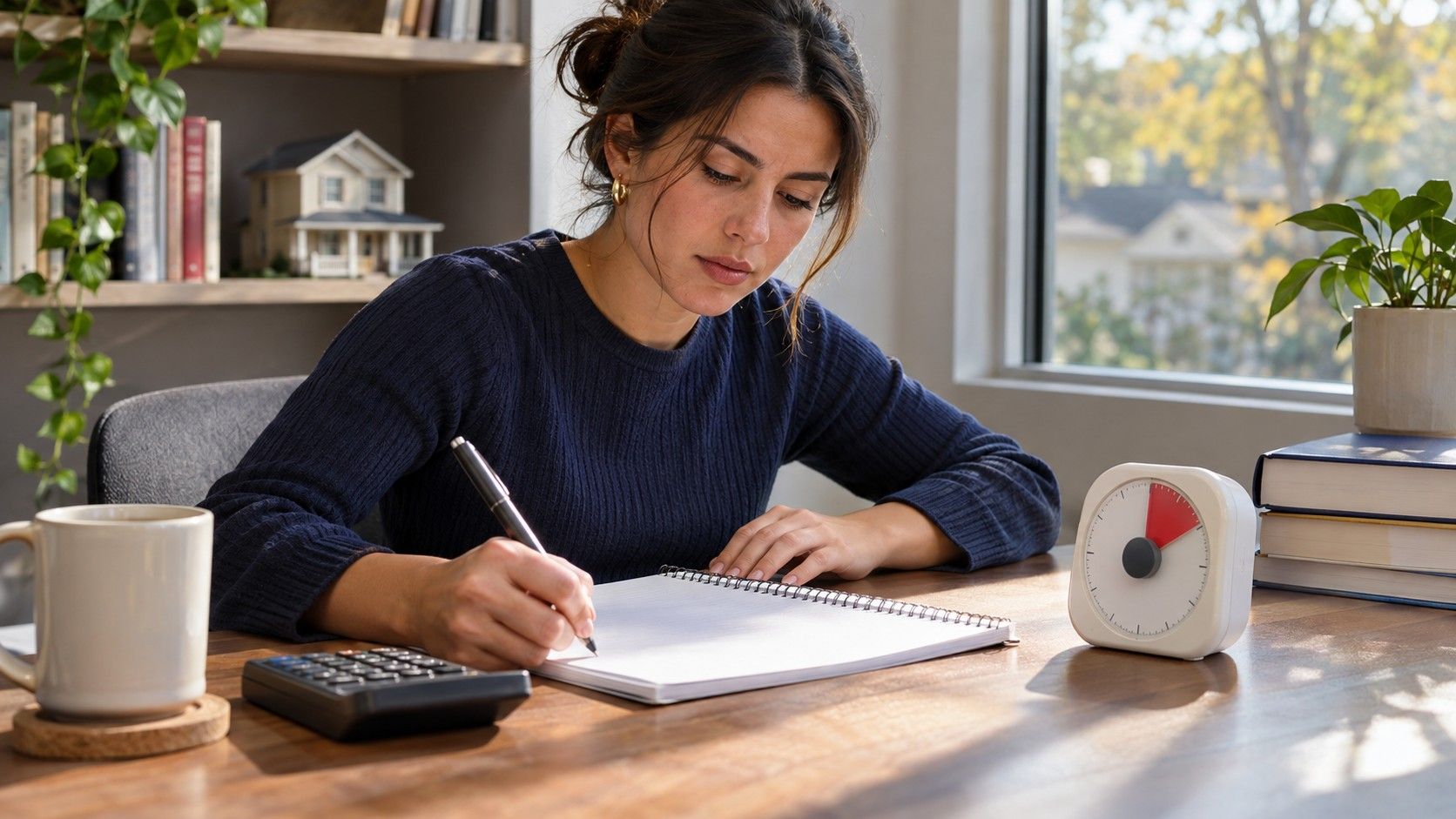
Pacing is a series of decisions about attention. Some questions need a calculation, some need a careful distinction and some can be answered directly. A useful time plan keeps a difficult item from consuming the opportunity to answer several others. Build it from your program's actual duration and navigation rules, then rehearse it with unfamiliar practice material rather than relying on a universal minutes-per-question formula.
Establish the time you can actually use
Read the timing information for your examination and distinguish test time from check-in, tutorial or breaks. Determine whether portions have separate clocks. If the program describes breaks, find out whether time continues during them. Your practice schedule should reflect those conditions rather than the total length of the appointment shown in a calendar.
For a hypothetical ninety-question practice set lasting 150 minutes, reserving fifteen minutes for review leaves 135 minutes for the first pass. That arithmetic gives a rough planning rate, not a command to spend exactly the same time on each item. Your real examination may have different numbers and rules. Use its published structure, and keep the plan simple enough to remember without repeatedly recalculating it during the test.
In a practice log, separate elapsed time from active difficulty. An item may take two minutes because its calculation is substantial, or because you reread a simple stem six times. The same duration calls for different repairs. For the calculation, practice setup and tool use; for repeated reading, identify the decisive task before moving to the options. Record a short reason beside the slowest few items and look for a pattern across sessions. This method produces a more useful pacing adjustment than simply setting a faster timer. You are improving the work that happens within the time, while preserving the careful distinctions that a licensing examination requires.
Use checkpoints instead of staring at the clock
Choose a few broad progress points in rehearsal. For example, compare time remaining after completing roughly one third and two thirds of a practice set. Frequent clock checks can break concentration without changing your choices. A small number of checkpoints shows whether your pace is broadly workable while leaving attention on the current question.
If you are behind, identify the behavior causing it. You might be rereading every option several times or spending too long trying to prove a difficult answer. Do not respond by rushing through all remaining items indiscriminately. Shorten unnecessary revisiting, use the program's navigation tools if available and preserve careful reading of the task. Speed that creates new misreadings does not recover useful time.
Give difficult questions a stopping rule
During practice, notice when additional time stops producing new reasoning. If you have read the stem, identified the issue and narrowed the options but remain stuck, another long stare may not help. Where the interface permits returning later, make the best supported selection, mark the item and move on. Learn the actual navigation rules before depending on that strategy.
Do not leave an answer blank solely because you intend to return unless you understand the program's scoring and completion rules. Likewise, do not assume every examination penalizes or does not penalize guessing. Read the instructions. The general skill is to recognize diminishing returns, preserve an answer where appropriate and stop one uncertain item from dominating the entire session.
Make calculation setup visible
Before calculating, write the requested quantity and units using the permitted scratch method. Distinguish a percentage, dollar amount, annual figure and monthly figure. A few seconds spent setting up the relationship can prevent a much longer sequence of correcting a calculation that answered the wrong question. Use the precision and rounding instruction supplied in the item.
Rehearse with the calculator type permitted by your program. Familiarity with a phone app does not establish proficiency with an on-screen or basic calculator. Practice entering values, checking a result and clearing an old calculation. When an answer is implausible, inspect the setup and units before repeating the same keystrokes. A correct computation of the wrong relationship remains a wrong answer.
Review selectively rather than restarting
A review period is most useful for unanswered or flagged questions and calculations that need a specific check. Rereading every settled answer can consume the margin without adding much evidence. During practice, record whether answer changes help or hurt and why. Distinguish a change supported by a newly noticed fact from one driven by unease about having chosen too many of one letter.
When reviewing, return to the question's task. Ask what fact would justify changing the selection. If no new reason exists, repeated switching is not analysis. For a calculation, check the quantity, units and arithmetic once. For a legal concept, check the governing jurisdiction and the distinction between the leading options. Keep the review tied to an identifiable uncertainty rather than a general desire to feel certain.
Rehearse pacing with fresh material and realistic limits
Use new sets aligned with the outline and apply the same checkpoint routine. Record completion time, accuracy and the items that caused delay. A faster result on a memorized bank does not show that your pacing has improved. Look for transfer to unfamiliar wording and a reduction in repeated behaviors such as unnecessary rereading or abandoned calculation setups.
If you consistently finish early but make reading errors, your task may be to slow down at decisive words rather than accelerate. If you run out of time despite sound understanding, practice moving on from low-yield struggles. The final plan should fit your own pattern and the actual interface. It should be a small set of habits you can use while thinking about real estate, not another complicated system to manage.